Laju Hijack
Independent Singapore’s First Brush
with International Terrorism.
with International Terrorism.
On 31 January 1974, four men posing as tourists going on a fishing
trip hired a boat from Jardine Steps. They were, in actual fact,
terrorists armed with pistols and explosives aiming to bomb the
Shell Oil Refinery on Pulau Bukom.
As the boat neared Pulau Bukom, the men knocked the boatman unconscious and headed for the Shell Oil Refinery on the island. They planted explosives on four oil tanks before hijacking the Laju, a ferryboat which had just arrived in Bukom. The four men commandeered the Laju, and held its crew members hostage.
As the boat neared Pulau Bukom, the men knocked the boatman unconscious and headed for the Shell Oil Refinery on the island. They planted explosives on four oil tanks before hijacking the Laju, a ferryboat which had just arrived in Bukom. The four men commandeered the Laju, and held its crew members hostage.
.jpeg)
At the Eastern Anchorage, the Laju was intercepted by the Singapore
Marine Police. Here, the four men announced that they were members of
the Japanese Red Army and the Popular Front for the Liberation of
Palestine. They had staged the Bukom operation in a bid to disrupt oil
supplies to South Vietnam and thus retaliate against imperialism and
show solidarity with the revolutionary forces in Vietnam.
After eight days of negotiations, the hijackers agreed to the government’s proposal to fly them out safely to Kuwait in exchange for the release of the hostages. Thirteen Singapore government officials acted as guarantors of their safety on the flight.
After eight days of negotiations, the hijackers agreed to the government’s proposal to fly them out safely to Kuwait in exchange for the release of the hostages. Thirteen Singapore government officials acted as guarantors of their safety on the flight.
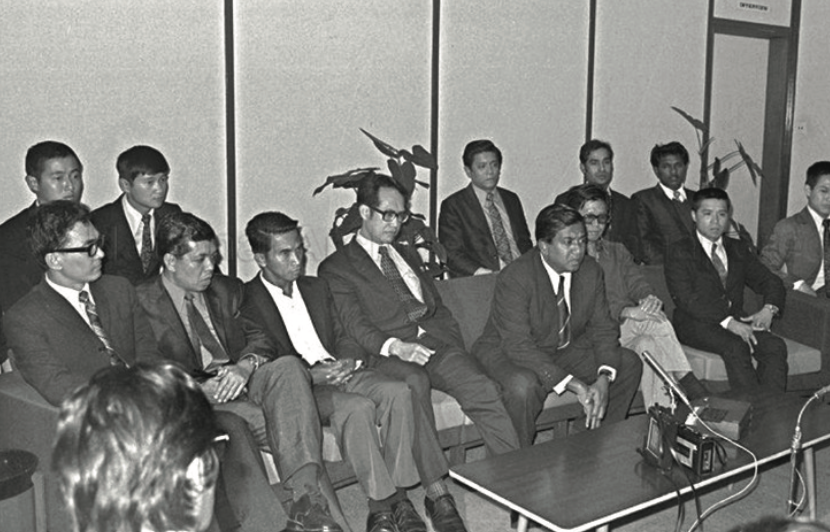
The 13 Singapore officials who acted as guarantors for the passage of
the terrorists on their return to Singapore.
Among them were then SID director S. R. Nathan (fourth from right, front row), Saraj Din (second from right, back row) and Seah Wai Toh (third from right, front row).
Source: The Straits Times © SPH Media Limited. Reprinted with permission.
Among them were then SID director S. R. Nathan (fourth from right, front row), Saraj Din (second from right, back row) and Seah Wai Toh (third from right, front row).
Source: The Straits Times © SPH Media Limited. Reprinted with permission.
The experiences of Home Team officers who were involved in this
incident..
“I promised to dedicate my life to the Force”
At the time of the incident, former Commissioner of Police Tee Tua Ba was Deputy Superintendent and was Officer Commanding (OC) to the Marine Police. He was among the first to jump onto a craft and head out to Pulau Bukom when news of the incident broke. He quickly took command of the situation and established a communication channel with the hijackers.
DSP Tee was present every day during the 8-day standoff and was later in charge of disarming the terrorists before allowing them to board the plane. The negotiation at the airport was tense.
At one point, DSP Tee drew his revolver and put it in the hand of the chief terrorist, allowing him to hold it to DSP Tee’s temple. “When I drew the Palestinian terrorist’s hand holding the revolver towards my head, an image of my two young sons quickly flashed across my mind. I wasn’t sure if I would see them again,” he recalled years after the event.
“But I promised myself that if I survived the ordeal, I would dedicate my life to the Force.”
At the time of the incident, former Commissioner of Police Tee Tua Ba was Deputy Superintendent and was Officer Commanding (OC) to the Marine Police. He was among the first to jump onto a craft and head out to Pulau Bukom when news of the incident broke. He quickly took command of the situation and established a communication channel with the hijackers.
DSP Tee was present every day during the 8-day standoff and was later in charge of disarming the terrorists before allowing them to board the plane. The negotiation at the airport was tense.
At one point, DSP Tee drew his revolver and put it in the hand of the chief terrorist, allowing him to hold it to DSP Tee’s temple. “When I drew the Palestinian terrorist’s hand holding the revolver towards my head, an image of my two young sons quickly flashed across my mind. I wasn’t sure if I would see them again,” he recalled years after the event.
“But I promised myself that if I survived the ordeal, I would dedicate my life to the Force.”